Showing posts with label Masakan. Show all posts

Saturday, January 18, 2020

LIVE Streaming RCTI MasterChef Indonesia Season 6 Sore Ini, Renatta Sebut Masakan Peserta 'Ancur' - Tribunnews

TRIBUNNEWS.COM - Simak link live streaming RCTI untuk menonton acara MasterChef Indonesia season 6, Sabtu (18/1/2020) sore ini.

Acara MasterChef Indonesia season 6 kembali hadir di RCTI sore ini dan telah memasuki episode ke-9.

Kontes memasak untuk koki amatir ini akan tayang di RCTI mulai pukul 16.30 WIB.

Anda dapat menyaksikan MasterChef Indonesia season 6 di HP lewat link live streaming yang diberikan Tribunnews.com.

(Link live streaming MasterChef Indonesia season 6 ada di akhir berita)

Dalam MasterChef Indonesia season 6 sore ini, para kontestan akan menghadapi sejumlah tantangan baru dan seru.

Mereka harus bisa menyelesaikan tantangan yang diberikan ketiga juri bila tak ingin masuk ke pressure test lantas tereliminasi.

Tak lain Chef Arnold Poernomo, Chef Junior Rorimpandey alias Juna, dan Chef Renatta Moeloek.

Hingga Sabtu (18/1/2020) sore, tersisa 20 peserta yang masih bertahan di Gallery MasterChef Indonesia season 6.

Mereka adalah:

Let's block ads! (Why?)

https://www.tribunnews.com/seleb/2020/01/18/live-streaming-rcti-masterchef-indonesia-season-6-sore-ini-renatta-sebut-masakan-peserta-ancur
Share:

Sunday, January 12, 2020

Komentar Kaesang dan Gibran di MasterChef Sampai Membuat Chef Renatta Tak Bisa Tahan Tawa - Tribunnews

TRIBUNNEWS.COM - Ada yang menarik dari MasterChef Indonesia 2020 yang tayang pada Minggu (12/1/2020), sore. Kali ini, kedua putra Presiden Jokowi unjuk gigi sebagai juri tamu di acara tersebut.

Mereka adalah Gibran Rakabuming Raka dan Kaesang Pangarep. Seperti yang diketahui, kedua putra presiden ini memang tak asing di dunia kuliner.

Gibran dan Kaesang sama-sama menekuni bisnis di bidang kuliner. Produk mereka bahkan hits dan laris di pasaran.

Sebut saja, Gibran yang terkenal sebagai pemilik usaha Markobar dan Kaesang yang dikenal karena usaha Sang Pisang.

Keduanya bahkan memiliki bisnis bersama berkolaborasi dengan chef terkenal yang juga satu di antara juri MasterChef Indonesia, Chef Arnold, yaitu Mangkok Ku.

Kini, di acara MasterChef Indonesia, Gibran dan Kaesang pun turut memberikan penilaian terhadap hasil masakan para kontestan.

Satu di antaranya pasangan kontestan Soni dan Vanty. Namun, dua kontestan ini justru mendapatkan komentar menohok dari putra Jokowi.

"Saya bingung mau ngomong apa. So far ini masakan kalian yang terburuk," kata Gibran.

Sementara itu, Kaesang juga melontarkan komentar yang menohok sekaligus menggelikan.

MasterChef Indonesia Season 6
MasterChef Indonesia Season 6 (Instagram/@masterchefina)

"Dish-nya enggak pedes sama sekali. Padahal saya suka pedes, tapi ini bener-bener enggak pedes. Dessert-nya rasanya lucu," kata Kaesang.

Mendengar komentar Kaesang, juri MasterChef Indonesia, Chef Renatta pun langsung menunjukkan reaksi tak terduga.

Ia yang semula terlihat cool, ekspresinya langsung berubah seketika.

Chef cantik ini langsung membekap mulutnya menggunakan telapak tangan karena menahan ketawa.

Let's block ads! (Why?)

https://www.tribunnews.com/seleb/2020/01/12/komentar-kaesang-dan-gibran-di-masterchef-sampai-membuat-chef-renatta-tak-bisa-tahan-tawa
Share:

Sunday, December 29, 2019

Top Indonesian Spices to Keep in Your Pantry - Indonesia Expat

Ever wondered what the distinct spices are that get sprinkled into your favourite lontong sayur, masakan padang, soto ayam, martabak, rendang, and sate ayam?

Indonesia’s multifaceted cuisine is heavily influenced by the Indian, Arabian, and Chinese traders that came to Indonesia long ago, bringing their essential ingredients with them. But, there are a few spices grown and found in Indonesia, considered as exotic to expats yet comforting to Indonesians.

Here are the top Indonesian spices you should store in your pantry to whip up your favourite Indonesian dish and serve as a natural remedy to get you through days when you’re feeling under the weather.

Clove (Source: Hello Sehat)

1. Clove
Maluku and Ambon are homes to the world’s biggest clove production. Used for its distinctive taste and as an herbal remedy to combat cold weather allergies, clove, or cengkeh, is a favourite spice of people in Europe and Asia. The Portuguese valued cloves at the same rate as gold in the past, and the Chinese Emperor believed people could have good breath after chewing cloves.

Pepper (Source: Jawa Pos)

2. Pepper
Lampung is the largest pepper producer in Indonesia. Almost 80 percent of Indonesian pepper is exported, making the country the second largest pepper exporter in the world. This original Indonesian spice warms our bodies and is also believed to cure influenza. Though there are two kinds of pepper, white and black pepper, Indonesians mostly uses white pepper, or merica.

Cinnamon (Source: Hello Sehat)

3. Cinnamon
Cinnamon, or kayu manis, like all other spices found in Indonesia, can be used to improve your health, it’s said to control blood sugar, relieve headaches for rheumatic patients, and prevent infection. There are four kinds of cinnamon: Ceylon, Cassia, Saigon, and Korintje. Indonesia is the chief producer of cassia cinnamon, a sharp scented, spicy, and quite bitter type.

Ginger (Source: Tribunnews)

4. Ginger
Food and beverages in Indonesia commonly have ginger, or jahe, as part of the recipe because of the warming feeling it gives, especially when someone has stomachache or a cold. One of the most popular beverages is wedang jahe, which is found pre-packaged in sachets or made from scratch. There are three kinds of ginger: white ginger, or jahe emprit, for foods and traditional herbal drinks; yellow ginger, or jahe gajah, for food; and red ginger for medicines and to make ginger oil.

Nutmeg (Source: Liputan 6)

5. Nutmeg
The nutmeg plantation in Banda Island, Maluku was controlled by the Dutch during their colonialist rule in Indonesia. Grown only in fertile and quite dry soil in the middle of s tropical climate, nutmeg, or pala, is used as a cooking ingredient, as well as in traditional medicines.

Lemongrass (Source: Mommy Asia)

6. Lemongrass
Shaped like a grass with a thick skin, coloured in yellow or green, lemongrass, or serai, contains citronella, which is an effective mosquito repellent. Besides, the oil can relieve bloated stomachs, can improve digestion, is used as a skin moisturiser, and also prevents body odour.

Cardamom (Source: Liputan 6)

7. Cardamom
Cardamom, or kapulaga, acts one of the world’s most expensive spices after saffron and vanilla, set at the same price as gold in international trade. Black cardamom is normally used as an ingredient to make curry, while the green one is an additional ingredient to make coffee, tea, and cookies.

See: Top 5 Traditional Markets in Indonesia

  •  
  •  
  •  
  •  
  •  
  •  
  •  
  •   
  •  
  •  

Let's block ads! (Why?)

https://indonesiaexpat.biz/featured/top-indonesian-spices-to-keep-in-your-pantry/
Share:

Friday, October 18, 2019

These Two Malaysians Are Living Their Dreams As Online Chefs - Rojak Daily

Remember the mouthwatering smell of authentic, home cooked meals wafting out of the kitchen once you come back home from a long day?

That smell reminds you of the cosiness of your home, where you spend hours and hours eating a perfect meal at your favourite spot in the living room or kitchen, savouring every mouthful that was lovingly cooked by your grandmother or mother.

If you are lucky enough to grow up in this sort of environment, the wonderful taste of home cooked meals must be the first thing that you miss when you are away from home.

Understandably, it is not easy to recreate the dishes you have fondly eaten since young because no matter how you try, it would not taste the same. Plus, you were probably too busy enjoying your food that you forgot to ask what goes into it or learn how it’s made.


But for those who would still love to give it a go, online cooking videos or tutorials come in handy to recreate dishes that taste the closest to the ones they get at home.

And because the demand for online cooking videos is high, online chefs (fashionably called online cooking stars), are emerging to virtually feed their
‘hungry’ followers with recipes that have been passed down the family for generations.

Many of these online cooking stars are ‘paid’ with gratitude and even fame, in exchange for their passion and generousity in sharing the recipes. There are still others who are so successful that they went on to write cook books and even become brand ambassadors.

Rojak Daily spoke to two online cooking stars who have found success.

Sheena showing her passion online.
Haseena Mohamed Ali, or better known as Sheena Haikal, is a household name in at least hundreds of thousands of homes in the country.

She was just like any home cook, enjoying her passion for food and experimenting in the kitchen, before she made it big with her online presence and influence.

Haseena said that she was blessed to grow up in an environment that embraces cooking as part of their lives.

“I learned cooking from my mum and dad. They are excellent cooks and my dad used to own a restaurant back then, when I was about nine years old. I assisted in the restaurant as much as I could.

Sheena learned to cook from her parents.
“From there, I observed the way he cooked. His methods. His secret recipes. Not long after that, he sold the restaurant and I begin to observe my mum’s cooking at home and learnt from there,” she said.

Haseena said her mom’s cooking lessons, coupled with her obsession with collecting cook books and trying out the recipes, led her to experiment vastly in the kitchen.

She tries to keep to the authenticity of the dishes as much as she can, but wherever the recipe allows, she adds a twist of her own to bring the dishes to another level altogether.

Haseena told us that by 16 years old, she was a full-fledged home cook.

“I remember my first dish was ‘cucur udang’ (prawn fritters). Everyone went crazy over it. That was a great motivation to me to cook more.

Self-made chef.
“My biggest critic and was my mum. She is also my biggest motivator.

“As I learnt to cook more, I ventured into cooking main dishes like rice and curry. In fact, I would often disturb my mom at work by calling her and asking for a certain recipe, then cooking it before she reaches home.

“The minute she reaches home from work, I would rush to her and impatiently ask her to taste the dishes I cooked. She has always been the quality controller for my dishes even until today,” the 32-year-old laughed.

Haseena’s passion for cooking now rubs off on her four-year-old son Aryan and she looks forward to passing on her skills to him.

Although cooking has always been her passion, stumbling upon online avenues and gaining fame from it was quite a coincidence.

Sheena slowly gained fame.
Haseena said she often shares the dishes she cooks on her personal Facebook page. However, one day, she got the idea of posting her dishes on a popular Facebook cooking group called ‘Masak Apa Hari Ini’.

“Upon posting the dishes there, many people started asking for the recipe. From there, I started posting recipes too, along with the photos of the dishes I cooked.

“My friends soon saw how popular my postings are and they encouraged me to start my own cooking and recipe page.

“I started my page Sheena’s Cooking Passion on 6 April 2016 and never looked back since,” she said.

Sheena shares a step-by-step recipe on her Facebook page.
For the past three years, Haseena has been diligently posting new recipes on her page, attracting new followers and growing her page without the help of the ‘boost’ function.

To date, she has over 200,000 followers who regularly share and comment on her postings.

Looking at the overwhelming response from her followers, she also created a Facebook group called “Let’s Cook With Sheena” where her followers share the dishes that they have cooked, largely inspired by Haseena’s recipes.

“My chicken briyani and butter chicken recipe are the most popular dishes on my page to date, with hundreds of thousands of shares,” she said.

Sheena is now a published author.
Haseena’s success with her own cooking page prompted her to realise her longtime dream – to publish a cook book of her own.

“Being an ardent collector of cook books since I was little, I have always dreamt of having my own cook book one day. However, the dream didn’t materialise because I could not find an appropriate publisher.

"Recently, I found a publisher to my liking, called MHK Communications. I approached them and they were more than happy to publish the first edition of cook book,” she explained.

Since Hassena already have all the recipes and photos, she just compiled everything in less than a month and sent the copy for publishing.

Called 'Sheena’s Kitchen Diary', the book boasts a total of 70 recipes printed on 147 pages.

“The book has a mixture of Malaysian recipes but with emphasis on Indian recipes. It has infographics, photos and step by step instructions. The recipes are very detailed, just like how I post on my page,” she said.

A dream come true for Sheena.
At first, Haseena was unsure of the response that she would be getting for the book as people can get some of the recipes on her Facebook page.

She tested the market by opening a pre-order, which requires a print-on-demand method to print the book.

“I was surprised to receive an overwhelming response to the book which retails at RM40. I received over 400 orders and had to close the orders.

“However, the orders kept on coming. I might open another pre-order soon,” she quipped.

Wanna learn how to make Deepavali cookies?
The encouraging response that she received for her first cook book, prompted her to come up with another book just in time for the Deepavali celebrations at the end of the month.

The limited-edition book is meant to help home cooks to whip up delicious meals for Deepavali. 

Moving forward, Haseena has several long term plans up her sleeves.

“I would like to conduct cooking classes in the future as the demand is increasing. I also have plans to sell my special homemade masala. There is also a plan underway to launch a cooking app.”

Who's Yatie? She's Yatie!
Mention the name Yatie Kitchen and almost immediately, delicious home cooked meals come to mind.

The person behind the famous Instagram account is bubbly Nurhayati Zainol Abidin, fondly called Kak Yatie, by her ardent fans and followers.

Her passion for cooking started at the tender age of 10, following the footsteps of her parents who are both great cooks.

“I am the second child of three siblings. We are all girls and love to watch our parents cook. I slowly learnt to cook from there. You’ll always find me in the kitchen,” she said.

She started her Instagram page, Yatie Kitchen, in 2015, simply to post her everyday cooking as an online journal.

Yatie and her fans.
She only had 300 followers at first and her detailed recipe only and her cooking videos slowly became a hit in the online community.

Her follower count has now reached more than 500,000, and that list includes VVIPs, royalties and even local celebrities like Siti Nurhaliza (she told us that Siti who loves her ‘Nasi Goreng Kampung’ and ‘Kacang Pool’ recipe).

Surprisingly, she even has a fan page called Yatie Kitchen Recipe on Facebook.

“I didn’t expect to get the response that I am getting now. I get gratitude messages every day from followers who call me their ‘cooking guru’. I am truly humbled by their response,” she said.

Yatie shares her recipes online.
The 42-year-old, who uses her smartphone to take photos and videos of her dishes, said one of her most popular dishes is the ‘Sotong Goreng Kunyit’ (Fried Tumeric Squid).

Her online popularity quickly attracted the attention of consumer company Adabi, and they wanted Nurhayati to come onboard as its ambassador. She was in total disbelief when the opportunity came knocking on her door.

“I’ve never dreamt of going far in this industry because I always think there are better people than me out there.

“In fact, when Adabi approached me, I was skeptical and told them I am not a celebrity. But they want someone who really loves cooking to represent them. I am really grateful for the opportunity,” she said.

Yatie now has her own book.
Nurhayati also recently published a book called ‘Koleksi Tips & Resipi Masakan Yatiekitchen’ which has all her recipes and cooking tips.

“I was not even planning to publish a book but when a publisher approached me to do so, I decided to jump on the bandwagon because Instagram could cease to exist one day, who knows.

“What’s special about the book is it has two versions. The first one is a regular cooking book and the second one is a special edition for the fasting month. It retails at RM45 and RM30 respectively,” she said.

She said to date, the book has received tremendous support and response.

“The public can get the book from Studio MHK , Bandar Tun Hussein Onn, Kyl’s Corner Bookstore and Plaza Metro Kajang. You can also get it online via my Yatie Kitchen Instagram comment section, where personal shoppers will assist you.

Big brands have come knocking.
And for those of you who are fasting, Nurhayati has one very simple tip.

“We have to pay extra attention to our stomach or digestive system during the fasting month. To avoid stomach ache, the food for ‘sahur’ has to be freshly cooked so that it is hot to be eaten. Keep it simple.

“Do not buy food and keep it overnight to be reheated during ‘sahur’,” she added.

Let's block ads! (Why?)

http://www.rojakdaily.com/lifestyle/article/7902/these-two-malaysians-are-living-their-dreams-as-online-chefs
Share:

Saturday, August 3, 2019

Max Verstappen Snatches his Maiden Pole Position in Hungary - Essentially Sports

History was made as Max Verstappen finally got the monkey off his back and snatched his maiden pole. In the process, he became the 100th pole-sitter in Formula One and he couldn’t have been happier. The Dutchman will start the race ahead of Valtteri Bottas and Lewis Hamilton and the two Ferraris.

The team crowed on the radio, “Better late than never”, as Verstappen had never started right up front. Naturally, Twitter was ecstatic and congratulations poured in for the young Red Bull driver.

Let's block ads! (Why?)

https://www.essentiallysports.com/max-verstappen-snatches-his-maiden-pole-position-in-hungary/
Share:

Max Verstappen Snatches his Maiden Pole Position in Hungary - Essentially Sports

History was made as Max Verstappen finally got the monkey off his back and snatched his maiden pole. In the process, he became the 100th pole-sitter in Formula One and he couldn’t have been happier. The Dutchman will start the race ahead of Valtteri Bottas and Lewis Hamilton and the two Ferraris.

The team crowed on the radio, “Better late than never”, as Verstappen had never started right up front. Naturally, Twitter was ecstatic and congratulations poured in for the young Red Bull driver.

Let's block ads! (Why?)

https://www.essentiallysports.com/max-verstappen-snatches-his-maiden-pole-position-in-hungary/
Share:

Sunday, June 23, 2019

Most number of asam pedas dishes sets new record - New Straits Times

[unable to retrieve full-text content]

Most number of asam pedas dishes sets new record  New Straits Times

MELAKA: A total of 135 asam pedas dishes produced at the Q'Fish Asam Pedas Challenge in conjunction with Cabaran Masakan Melaka 2019 programme at ...

https://www.nst.com.my/news/nation/2019/06/498455/most-number-asam-pedas-dishes-sets-new-record
Share:

Monday, June 17, 2019

How my Syrian friend and teacher was reduced to a desperate gamble - TRT World

Aliaa is now living in sanctuary after a brutal journey that nearly killed her.

We sat outside of Aliaa’s small house, flicking through the pictures on my laptop, pointing at faces, exchanging gossip about friends – something we had done many times before. Normally, it would have been on a patio or terrace in Damascus, with the sound of the Muezzin in the distance, but these days it is in a quiet town in southern Germany. Aliaa has lived quite a life since we last met.

The photos always showed us smiling – at a party, a wedding, or at someone’s house watching a World Cup game while cooking kebabs on a barbecue. There are images of us sitting at desks covered with Arabic textbooks, and even one where we are on a rickety bus with friends heading through the desert to Palmyra. The pictures of that trip produced most laughter – especially one mutual friend who, not for the first time, climbed onto the roof of our fast-moving bus. We had only got him back inside the bus when we spotted a Syrian police checkpoint ahead. Those were innocent days. 

“Remember that? Seven years ago now . . . Raya is in Sweden these days, Abed lives in London, George has stayed there.” There was an air of sadness, too. I was just a visitor who had lived in Syria for a year and half, and these were places that held great memories for me. For Aliaa and her husband, Mohammed, it was home. Now living in sanctuary after a brutal journey that nearly killed them, they looked back to a homeland that they may never see again.

Disneyland

I went to Damascus in 2009 to learn Arabic, taking a sabbatical from my job at the BBC in London. Having learned to speak Spanish relatively well in recent years, I knew Arabic was much tougher and would take far longer, so I had given myself a year at least. Like many before, I had no idea how difficult it was, or how rewarding it might be.  

I had made prior contact with the University of Damascus, which offered courses “from zero” as they told me, for people with no knowledge of the language. However, after finding somewhere in Damascus to live, with a family in the backstreets of the old city, I soon realised the university course was not going to work out after all. I was in a class with people who had studied the language before and it was not remotely tailored to a starter like myself, so I started looking around for another solution.  

A friend who had a berth in another house knew of a private teacher and she made the connection. Over coffee, after about thirty minutes, Aliaa had explained more to me about the rudiments of the language than I had gained in two weeks in the classroom. I learned about the root structure, how the baffling letters changed shape depending on where they were in a word, but Aliaa also imbued a love of the language. 

She showed me the beauty of the writing and had me scribble the letters and words. As a right-handed journalist whose once-neat script had been reduced to an impenetrable scrawl after many years of fast-paced work, I was creating beautiful shapes and writing in the opposite direction, from the right side of the page heading left. It felt easy and fluid. What is more, I liked Aliaa. 

I had found my teacher, but what I did not realise at the time was that I had gained a true friend.

Each morning I would wake up early and read through the two-hour lessons we had the day before. Aliaa would arrive, make tea, and smoke her incessant cigarettes while banished to a far corner of the terrace, and then we would sit down and plough through vocabulary and grammar. 

“Today we are studying politics,” she would announce, and then we would lower our voices as we discussed terms like government, democracy, dictatorship, and whisper the words “Israel,” or, as we called it, “Disneyland.”

I reciprocated the teaching with an hour or so of English study, although she already spoke it surprisingly well, having been mainly self-taught. More than verbs and vocabulary, Aliaa introduced me to a life that I may never have seen, to the ways and mores of a kind and generous people. How to make sense of the baffling mini-bus service that ran irregular routes all over Damascus. What was the best food to order and where? Even how to haggle in the Souk Al-Hamidiyah. “Walk away, walk away,” she would whisper. “He will follow.”

It was all one large field trip, often taking the Arabic out of the classroom and onto the old streets of Damascus. We were at weddings in Yarmouk (later to become a Daesh stronghold), parties in Mezzeh, and we had our lessons everywhere. So difficult was the language, and yet so much fun was the life there, that I extended my time. But in my second year, life started to change around us. It was a gradual build-up to war, beginning with the police brutalising teenagers who had spray-painted a wall with anti-government graffiti in De’raa, in the south of the country. 

Then the police began to shoot at protestors. Like all governments who shoot unarmed people, they claimed they had been attacked by “terrorists,” but it was a display of ruthlessness that was very concerning. De’raa seemed like a terrible incident, a period of tension that would be quashed as others had been before. We never imagined quite how evil it would become. 

Gradually the neighbourhood where I was living became less friendly. Quiet, somewhat sullen men in leather jackets occupied street corners and would stare as you passed. “Who are they?” I would ask shopkeepers I knew well and often chatted with. “Police,” I was told, very quietly.

The demonstrations I saw in Damascus were pro-regime. More than once I was caught up a vast throng of people shouting: “Allah, Sou’reeah, Bashar ou bas” – God, Syria, and Bashar al Assad is all we need. It reminded me of being on football terraces in the north of England in the 1980s, but I knew these were dangerous times.

Ghosts and Shadows

I left Syria very reluctantly. Back in London at my job at the BBC, Aliaa and I spoke often on Skype or by phone as things worsened. Neighbourhoods I had known well, like Yarmouk, were devastated. Masakan Barzeh, where I had lived for awhile, was attacked by tanks. Day by day, familiar towns and cities were succumbing to the horror of brutality against anti-regime protesters, with the constant refrain from the regime of “terrorists.” So-called political extremists who had been jailed by Assad in the years before, were released, allowing the regime to justify their claims.

Aliaa was at first reluctant to leave. Syria was her home, she was originally from the north, but Damascus was her place. “I’m staying here,” she would say, and more than once she said quietly, “Once this is all over it will be great, there will be a hafleh" using the Arabic word for party. I kept telling her she should leave, that there would not be a party, and that if the Assad regime fell, as we expected then, there would be fearsome bloodletting.

She kept me informed of the growing influence of the Shabihah, meaning ghosts or shadows; the government-linked militias that now controlled the streets in certain areas. How dark it was all becoming. The one thing that really struck a chord for me was some time in 2013, when Aliaa said that the cats were quiet, she rarely heard them. The famous Damascus street cats who would keep you awake with their yowling, were now subdued and mostly silent.

Eventually Aliaa, like so many others, would leave. First to Beirut to work as a journalist, and then to Istanbul as a refugee. She became one of the many – one of the 5.6 million Syrians exiled overseas, over 3.5 million in Turkey alone. And that is not counting the 6.6 million people displaced within Syria, according to the UNHCR. This is the tragedy of our times, one that made people like Aliaa and Mohammed risk their lives to escape.

More than once Aliaa spoke of heading to Europe, knowing that life as a refugee in Turkey, while safe, was not legal and they would not have much of a future there. One day she mentioned in passing they may have found a possible way, but she was economical with the details, telling me that if it happened, they had an “official boat,” but it was “nothing to worry about.” I was not the only one that she did not tell when she took the boat; her family had no idea either.

Across the Aegean

Two years later we sat outside of her home in Germany as she took me through the details. We watched the footage that she had filmed of Mohammed and their friend Tarek, happily walking the streets of Izmir in the south of Turkey, laughing and shouting. They were heading towards what would be an overcrowded boat that would take them across the Aegean to Europe. As we watched, the video became more harrowing.

These were pictures that by then were familiar to me, to the world, of desperate men, women, and children clinging to rubber dinghies that sat low in the water. Except in this case they were friends of mine, reduced to a desperate gamble. “You don’t think about the risk you are taking,” Aliaa told me as we drank tea. “But the moment the smugglers said, ‘To the boats,’ is where the drama started.” One hundred and fifty metres offshore, the smuggler steering the packed boat drove overboard and left them alone at sea in the dark. Shortly thereafter, the engine failed and it seemed very bad. The video shows flickering lights, and you can hear panic rising in Aliaa’s voice shouting in English. “Hello!” she shouts as another boat approaches. “We need some help here!”

As I sat and interviewed her for a TRT World report about the journey, she spoke emotively of the experience she thought they might not survive. “I was thinking of all you guys, my friends and family. I was saying if I had done something wrong to someone I hope they will forgive me. I was just cleaning my heart,” she said.

By chance they were spotted and rescued by the Greek coastguards. The pictures show beaming faces, out of relief more than anything. The next two weeks I did not hear anything from her, no one had. We had heard they had made it to Europe, but no more. I was annoyed she had not been honest about the dangers, but I realised she was just trying, as ever, not to worry anyone. We hoped all was well, but nothing about what has happened to Syria – to places we loved, or to friends – was really surprising anymore. The Syria of smiles and laughter we knew before the war was now a mirage, it no longer existed. 

Aliaa, Mohammed, and Tarek landed in Athens and then managed to make their way slowly through southern Europe. They paid smugglers to take them on a tortuous overnight hike across the mountains from Albania to Kosovo while keeping a lookout for bears – the journey took over ten hours. The rucksacks they had brought from Turkey were slowly shed of their weight and items deemed unnecessary. Carefully, they made their way across borders by foot, car, and train, avoiding the police as they went, or anyone who would turn them back. Germany was the goal, and it was once they were in Munich that they resurfaced to let us know that they were fine, if exhausted.

'The auslander'

Soon after, I went to see them. They were in a quiet town, crammed into a room in a small block of flats that were reserved for refugees. The language spoken was Arabic, you left your shoes at the door, and the smells of Iraqi and Syrian food permeated the air. It was their first stop as they entered the refugee system the German government was establishing to help the new arrivals. 

 As we walked around the town one warm day, the calmness of the place struck me. I had not seen Aliaa in over three years. She was, on the outside, the same person, running and skipping towards the train station where I arrived, shouting “Merhabar” loudly from across the street. But the Damascus we had both loved was a heaving maelstrom of activity, noise, and chaos. Aliaa herself had the same characteristics at times. This place on a beautiful river, not far from Stuttgart, was the complete contrast. Quiet, reserved, and of course very Germanic. I wondered how they would fit in.

I was back a few months later when friends from all over convened for a boisterous and entirely typical Syrian wedding. Aliaa and Mohamed were then married, loud Arabic music pumped out all night long as once again the Syrians taught the ajanib (foreigners), myself included, how to dance the traditional Dabkeh, as we had done many times in Damascus, Homs, and Palmyra. 

Except this time they were the foreigners – or as the Germans would call them, auslanders – making their way in a strange land, as we once did with their help.

What Germany has done for refugees warms me, but I also see it as a basic human obligation, to help others as they would help you. And I have rarely met more generous, open people than the Syrians. For many, my friends included, Germany became the sanctuary that America once was to previous generations of desperate people. Those close to me who have their family histories scarred by what Germany once was, of Nazism, concentration camps, and the Holocaust, now see Angela Merkel and the current Germany as a shining beacon.

Germany has created a system that will yield dividends. By nature, the Levantine people are hard working and innovative. The decisions of Merkel in giving over a million people a refuge, may yet prove to be far-sighted. As an Englishman , albeit it someone who has lived many years outside of Britain, I feel ashamed at the way my country treats refugees. The fifth-largest economy in the world has accepted a paltry number of Syrian refugees, barely 10,000. By comparison, Turkey has accepted over three million people. 

The only thing I can offer to foreign friends who ask about this, is to remind them that Britain is an island, with an island mentality and a history of being invaded – and doing a heck of lot of invading themselves. Unlike in continental Europe, the borders were rarely fluid. I may be wrong, but despite immigration and a multicultural Britain, there seems to be a form of inbuilt xenophobia that is easily exploited by right-wing media and scare-mongering politicians.

I do not write this thinking everything has been wonderful for refugees once they have found a home in Germany and elsewhere. For every Aliaa, Mohammed, and Tarek, who are clever and worldly enough to assimilate and learn languages, there are others who will always struggle. Those who will not be accepted, who will always look back to a life before the war in Syria, and who will be called “auslander.” I do worry when I hear of attacks on refugees.

Frau Wolf is a social worker who has been looking after Aliaa and Mohammed since they arrived. They have thrived, and within two years they were speaking German at university level, but not everyone succeeds like this. As we spoke in her office, Frau Wolf explained the difficulties. “The expectations of the refugees who arrive in Germany are too high and unrealistic. They are expecting to get a private flat in a couple weeks and find a job quickly that they can lead in their home culture. This is the ideal vision they have, but this, of course, is very difficult.”

These are, after all, people who have had to leave everything behind. Jobs, families, homes, a culture, and all they have known. To arrive in an alien country, learn the language, fit in, and thrive is an immense challenge. It is one we all hope does not happen to us because of war. Both my parents lived through the Second World War as children, my grandfather fought through the First World War. I have a photo of him with three school friends who all signed up to fight on the same day in London. He was the only one of the group who survived and returned home. I am part of a blessed generation of Europeans who have not had to go to war or become refugees in a foreign land, and it is something I have taken for granted. 

And yet my friendship with Syrians, who are now scattered, has taught me that there is no difference between the likes of myself and Aliaa, apart from my passport. My place of birth has given me chances and, ultimately, protection. She is from a country that has been essentially reduced to rubble, and which is still led by a brutal dictatorship that will readily kill its own people today, just as it did in De’raa early in 2011. 

Aliaa and Mohammed are in a good place. They seem happy, and when I last visited the barbecue was fired up and the kebabs tasted just as good as the ones we used to cook. They miss home and their families, but recently they had their first child. Germany, a country that knows the pain of war and destruction, has allowed them to start again and have a future. It is also a place that will give their daughter a far better chance in life, and much more security than they could have in Syria today.

[NOTE: The narrative is an excerpt taken from The Refugee's Messenger Lost Stories Retold, published by TRT World Research Centre.]

Source: TRT World

Let's block ads! (Why?)

https://www.trtworld.com/perspectives/how-my-syrian-friend-and-teacher-was-reduced-to-a-desperate-gamble-27540
Share:

Saturday, January 5, 2019

Indonesia's diversity through food photography - The Jakarta Post - Jakarta Post

Food is key to bringing people of different backgrounds and cultures together, as the Indonesian Culinary Photography Exhibition shows at the GoetheHaus in Central Jakarta.

The exhibition, which runs through Dec. 17, aims to raise awareness about the diversity of Indonesian cuisine and the importance of preserving it.

“We believe that preserving our culinary heritage strengthens us as a community, locally and globally,” said Wilton Djaya, content creator of the Goethe-Institut and a juror of the photo exhibition.

He said it was also important for Goethe-Institut to hold the exhibition, as food could be a medium of cultural exchange between Germany and Indonesia.

The exhibition features works curated from the institute’s Instagram competition on food photography held throughout the country. Fifteen photographs were selected from 321 submissions to portray Indonesia’s rich culinary diversity from Banda Aceh in Aceh to Timika in Papua.

More than just showcasing the food, these photographs also tell the stories behind the food and how these dishes are able to portray their culture of origin.

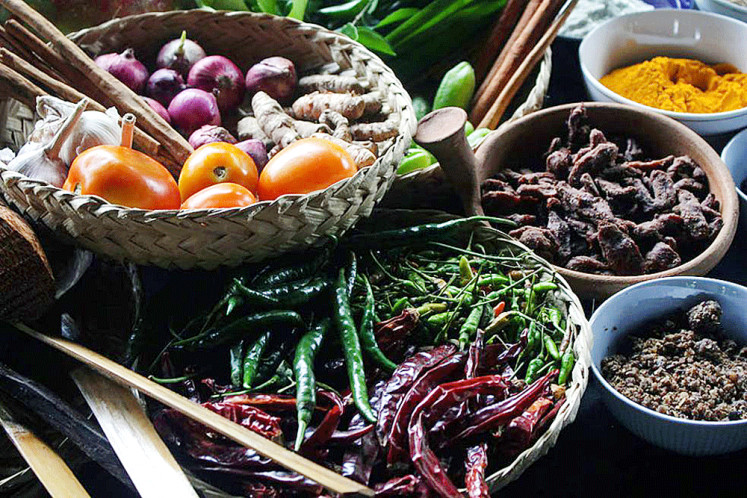
Bumbu Masakan Aceh by Ade Armanda Bumbu Masakan Aceh by Ade Armanda (Courtesy of Goethe-Institut Indonesien/-)

“These 15 entries represent Indonesia — not only with good quality photographic esthetics, but also regarding high-quality storytelling,” said Wilton.

Curator Ng Swan Ti wants to give visitors a taste of what it feels like to explore and travel multicultural Indonesia through these unique photographs of each region’s signature dish.

One of the more interesting and powerful photos in the exhibit is Babi Bakar Batu (Stone-Roasted Pork) by Albertus Vembri, who goes by his second name.

The dish, which was photographed in the city of Timika, reveals the unique process behind its preparation. Unlike most roasting in which charcoal is used as main source of heat, babi bakar batu uses pre-heated stones.

Vembri explained that the use of stones was significant not only in cooking the dish, but that it also served as a ritual to express happiness or grief, or when people begin a new community project.

He agreed that a region’s cuisine portrayed its culture and values, a correlation that was particularly evident in the cooking tradition of babi bakar batu.

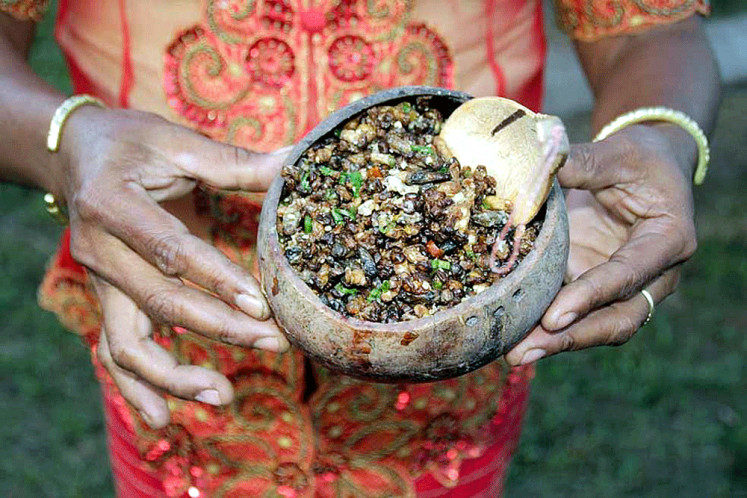
Luat Sarang Lebah (Kupang, East Nusa Tenggara) by Silvania Stella Epiphania Mandaru Luat Sarang Lebah (Kupang, East Nusa Tenggara) by Silvania Stella Epiphania Mandaru (Courtesy of Goethe-Institut Indonesien/-)

“Cuisine is interconnected to culture,” Vembri said over phone. “Babi bakar batu shows how people are able to work together as communities — which community provides what ingredients, which community plays what role. They all work together and in the end, they enjoy the food together. It shows their togetherness, since babi bakar batu is never prepared by just one or two people.”

Another interesting photo is Luat Sarang Lebah (Beehive “Expectorate”) by Silvania Stella Epiphania Mandaru.

Stella describes luat sarang lebah as a high-protein chili sauce made from bee larvae that is consumed at various events in the village of Amfoang in Kupang, East Nusa Tenggara.

Like the other photos, Luat Sarang Lebah does not only reveal the dish’s uniqueness as a cuisine but, most interestingly, showcases the ritual surrounding the dish’s preparation.

In harvesting the honeycomb, the villagers of Amfoang “sing” poetry to lull the queen bee into surrendering the honey willingly. In the description accompanying her photograph, Silvania said the ritual was performed because the people of Amfoang believed bees should be treated like beautiful women.

Nasi Sayur Lodeh Ikan Tongkol (Malang, East Java) by Desy Bariyyatul Qibtiyah Nasi Sayur Lodeh Ikan Tongkol (Malang, East Java) by Desy Bariyyatul Qibtiyah (Courtesy of Goethe-Institut Indonesien/-)

Another photo, Bumbu Masakan Aceh (Aceh Seasonings) by Ade Armanda, captures the spices typically used in Acehnese dishes. The photograph portrays a vast array of the daily ingredients the people use in the region, which is known for its rich spices and spicy foods.

Ade also provides a historical context for his photograph, explaining how Aceh used to be a hub of foreign trade and how it influenced the wide range of spices that are used in Acehnese dishes, even today.

As part of the exhibit, the jury selected the five best photographs from those on display.

Wilton said the jury was given different sets of criteria to assess the entries, such as original idea, storytelling and esthetics as well as whether the ingredients were indigenous to a remote area and whether the food would be appealing to the Goethe-Institut’s target group.

The five winners would receive awards, including dining at Goethe’s Magic Hour Dinner, an exclusive dinner event hosted by German chef Helge Hagemann and Indonesian chef Petty Elliott at a pop-up restaurant at Goethe-Institut Jakarta.

As the curator of the exhibition, Swan Ti said she also learned about how rich and diverse Indonesia’s culinary traditions were. “There were several foods that I was not familiar with before,” she said, adding that she hoped visitors to the exhibit would also learn something similar.

— The writer is an intern at The Jakarta Post.

Let's block ads! (Why?)

https://www.thejakartapost.com/life/2018/12/11/indonesias-diversity-through-food-photography.html
Share:

Sunday, December 9, 2018

Sunday, November 25, 2018

Tips Menyelamatkan Masakan yang Terlalu Pedas

Fimela.com, Jakarta Memasak sebenarnya mudah, tapi harus benar-benar tahu takaran yang pas dalam mengolah bahan-bahannya. Kadang masakan bisa jadi terlalu pedas. Rasa pedas memang lezat, namun jika terlalu banyak akan merusak cita rasa. Nah, lalu bagaimana sih cara untuk menyelamatkan masakan yang terlalu pedas?

Yang pertama bisa dicoba adalah tambahkan beberapa bahan yang memberi rasa asam. Ini karena asam bisa membantu menurunkan rasa pedas. Tambahkan saja beberapa bahan seperti perasan jeruk, irisan tomat, potongan nanas, cuka, dan lain sebagainya untuk menyelamatkan masakan yang terlalu pedas.

Beberapa sayuran juga bermanfaat mengurangi rasa pedas. Ini karena sayuran ini mengandung gula alami. Sayuran ini diantaranya kentang, wortel, timun, brokoli, dan lainnya.

Cara selanjutnya yang bisa dicoba adalah dengan menambahkan rasa manis. Gula pasir, gula merah dan madu bisa jadi alternatif yang pas. Tapi yang perlu dicatat jangan terlalu banyak menambahkannya karena malah akan merusak rasa makanan.

Air kaldu ternyata juga bermanfaat untuk mengurangi rasa pedas lho. Ada juga kacang-kacangan yang menyerap rasa pedas dan menambah sensasi rasa gurih dalam masakan.

Nah, semoga informasi ini bermanfaat untukmu ya.

Let's block ads! (Why?)

https://www.fimela.com/lifestyle-relationship/read/3730461/tips-menyelamatkan-masakan-yang-terlalu-pedas
Share:

Rahasia Kelezatan Masakan Indonesia

Di dapur masyarakat Indonesia, sejumlah bumbu dasar menjadi penopang utama kelezatan rasa setiap sajian kuliner Indonesia.

Masakan Indonesia memang sudah kian berkembang. Banyak kuliner Indonesia yang mengadopsi masakan ala barat, ne­gara-negara Asia Timur, bahkan Ti­mur Tengah, bahkan Amerika Latin.

Hanya saja, yang membanggakan, meski serbuan kuliner mancanegara sudah sangat masif, rasa masakan khas Indonesia tetap mampu men­jadi juara. Kehebatan rasa kuliner Indonesia ini, antara lain dipe­ngaruhi oleh racikan bumbu dasar yang khas.

Memang, penggunaan bumbu selain sebagai penguat rasa, juga berperan sebagai pengawet alamiah yang menyegarkan.

Ya, tak bisa dipungkiri perpaduan beragam bumbu dan rempah yang dalam masakan Indonesia. Paduan renpah ini sangat berperan mem­perkaya rasa sajian dari setiap sajian kuliner nusantara.

Bumbu dasar sebenarnya merupakan bumbu yang bayak digunakan dalam setiap masakan Indonesia. Komposisinya biasa­nya berupa campuran dari bawang merah, bawang putih, garam serta bahan tambahan lainnya seperti kemiri, ketumbar, jahe, merica atau lada maupun rempah lain seperti kunyit dan juga cabai.

Beberapa bahan dalam bumbu dasar juga berperan dalam mem­berikan warna masakan seperti kuyit misalnya. Penggunaan bumbu sen­diri sangat diperlukan dalam peng­olahan makanan karena bumbu memiliki banyak peran.

Bumbu tak hanya memberikan rasa atau meningkatkan aroma pada makanan, beberapa bumbu yang ditambahkan dalam pengolahan makanan juga dapat berfungsi se­cara estetika untuk mempercantik masakan.

Hal ini untuk membantu merang­sang proses pencernaan makanan menjadi lebih baik. Penggunaan bumbu tertentu juga berperan seba­gai pengawet alamiah seperti peng­gunaan kunir misalnya.

Dalam dapur masyarakat Indone­sia, setidaknya mengenal tiga jenis bumbu dasar yang dapat diolah menjadi berbagai rupa sajian kuliner yang lezat. Mulai dari tumisan, lalu panggangan hingga kuliner berkuah. Ketiga bumbu dasar tersebut antara lain, bumbu dasar putih, bumbu dasar merah, dan bumbu dasar ku­ning.

Pakar kuliner, Sisca, mengata­kan bumbu menjadi inti dari setiap masakan Indonesia. “Makanan Indonesia itu sangat beragam. Tapi pada dasarnya memiliki kesamaan dalam hal bumbunya,” kata Sisca beberapa waktu lalu. Sisca sendiri banyak mengulas mengenai bumbu dasar ini dalam sejumlah buku kuliner karyanya.

Pemberian nama bumbu dasar sendiri lebih di dasarkan pada warna dari bumbu dasar tersebut. Misalnya bumbu dasar putih yang merupakan bumbu dasar hasil racikan dari kemiri, bawang merah, bawang putih, ketumbar dan juga garam. Warna putih dan biasa digu­nakan untuk olahan seperti tumisan.

Menurut Sisca, salah satu bumbu yang dapat digunakan di hampir semua jenis masakan Indonesia adalah bumbu dasar berwarna putih atau disebut bumbu dasar putih. Penggunaan bumbu dasar putih mampu menghasilkan masakan de­ngan cita rasa yang gurih.

“Rahasia kelezatan bumbu dasar putih itu terletak pada ketepatan formula penggunaan bahan-ba­han utama seperti bawang merah dan bawang putih, kemiri ataupun ketumbar,” tambah Sisca.

Untuk menghasilkan sajian de­ngan bumbu dasar putih yang sem­purna, terkadang beberapa rempah lain juga perlu ditambahkan. Baik itu berupa rempah daun ataupun rempah lainnya seperti kayu manis, cengkeh dan lain sebagainya.

Tak lupa proses penumisan bum­bu yang juga akan mempengaruhi kelezatan dari sajian kuliner dengan bumbu dasar putih ini. “Sebaiknya perbandinganya 5 : 1. Misalnya seki­tar 500 gram ditumis dengan minyak sekitar 100 ml sampai benar-benar harum,” kata Sisca.

Selain bumbu dasar putih, dapur masyarakat Indonesia juga menge­nal bumbu dasar merah. Untuk membuatnya, Anda hanya perlu menambahkan cabai merah pada campuran bawang merah, bawang putih, serta kemiri dan garam.

Bumbu dasar merah ini memiliki tampilan sajian merah yang menarik dan biasanya bayak diaplikasikan pada olahan seperti aneka balado ataupun sambal goreng. Sajian Indonesia yang kerap mengguna­kan bumbu dasar adalah masakan padang.

Tidak hanya kedua bumbu dasar tersebut, di Indonesia juga menge­nal bumbu dasar kuning. Selain me­nambahkan kunyit sebagai pewarna makanan, bumbu dasar kuning juga jauh lebih kompleks.

Hal tersebut karena penambahan sejumlah bahan lain seperti jahe dan lada, termasuk juga kayu manis ataupun biji pala yang menyem­purnakan rasa sajian dari olahan bumbu dasar kuning ini.

Bumbu dasar kuning ini dapat dikreasikan dalam sejumlah masak­an seperti aneka soto, ataupun pes­mol dan juga acar kuning. Bumbu kuning juga bisa digunakan sebagai bumbu ungkep ayam sebelum ayam digoreng atau di bakar. nik/berbagai sumber/E-6

Racikan Rempah Penggugah Selera

Secara umum masakan Indo­nesia diracik dengan beragam jenis rempah. Beberapa jenis masakah malah memiliki kemi­ripan dalam penggunaan bumbu-bumbunya sehingga menyiapkan bumbu-bumbu dasar menjadi salah satu solusi cerdas di dapur.

Beberapa produsen memang me­nyediakan beragam bumbu instan yang dapat dengan mudah ditemui di pasaran. Namun tentu saja, akan jauh lebih baik jika meracik sendiri bumbu-bumbu dasar di rumah.

Jika meracik bumbu setiap hari membuat anda kerepotan, maka ti­dak ada salahnya untuk menyiapkan bumbu dasar dalam porsi banyak sekaligus dan menyimpannya untuk digunakan sehari-hari.

Untuk membuat bumbu dasar yang awet dan berkualitas setidak­nya ada beberapa hal yang harus diperhatikan saat meracik bumbu-bumbu dasar.

  1. Siapkan bahan-bahan untuk bumbu dasar seperti bawang merah, bawang putih, kuyit dan lain sebagainya yang segar dan berkualitas. Jika bahan yang digu­nakan tidak segar, maka bumbu halus menjadi cepat basi dan aromanya tidak akan muncul.
  2. Tambahkan garam dalam bumbu dasar setiap bumbu dasar yang anda buat. Terutama untuk bum­bu dasar putih dan bumbu dasar kuning. Penambahan garam akan membuat bumbu dasar tahan lama.
  3. Simpan bumbu dasar tersebut dalam wadah yang bersih dan tertutup. Pastikan penutupnya tertutup rapat atau jika memi­liki bayak waktu, kemas dalam kemasan-kemasan kecil sekali pakai. Saat akan menggunakan, tinggal tambahkan rempah daun ataupun rempah lainnya.

nik/E-6

Mengolah Bumbu Siap Saji

Bumbu dasar putih menjadi salah satu bumbu dasar yang paling banyak diaplikasikan dalam masakan Indonesia. Penggunaannya juga cukup luas dalam berbagai kreasi.

Anda hanya perlu menam-bahkan beberapa tambahan bahan saat akan mengolah makanan dari bumbu dasar putih ini. Berikut resep membuat bumbu dasar putih yang bisa dilakukan dan disiapkan di rumah.

Bahan :

- 250 gram bawang merah

- 100 gram bawang putih

- 50 gram kemiri sangrai

- 3 cm lengkuas dirajang halus

- Garam

Cara membuat :

  1. Rajang kecil-kecil bawang merah dan bawang putih
  2. Haluskan bawang merah dan bawang putih serta kemiri dan juga lengkuas sampai halus
  3. Tambahkan dengan garam dan aduk rata.
  4. Simpan bumbu dasar putih ini di dalam wadah yang bersih dan kering nik/E-6

Let's block ads! (Why?)

http://www.koran-jakarta.com/rahasia-kelezatan-masakan-indonesia/
Share: